
Last Updated: November 16, 2026
Quick Summary
The florida firearm transfer legal process starts with confirming the recipient can legally own the firearm, then verifying ID and residency, checking prohibited-person status, and documenting the make, model, and serial number. Use a licensed dealer for interstate or NFA transfers, and confirm the waiting period with the dealer before pickup.
- A licensed dealer must complete an ATF Form 4473 and run a NICS background check before releasing a firearm.
- Florida does not require a background check for every private sale, so diligence falls on the parties.
- A private firearm transfer form should list full names, ID numbers, firearm details, date, and signatures.
- A firearm bill of sale proves the firearm left your possession on a specific date to a specific person.
- Inheritance is still a transfer, and an executor must confirm each heir is eligible to possess the firearm.
Table of Contents
- Who Can Legally Receive a Firearm in Florida
- Florida Private Firearm Sale Laws: What the Statute Actually Requires
- When a Licensed Dealer Must Handle the Florida Firearm Transfer
- What a Private Firearm Transfer Form Should Include
- Firearm Bill of Sale Florida: Your Written Record
- Florida Firearm Gift Rules for Family and Friends
- A Step-by-Step Transfer Checklist Before You Hand Over the Firearm
- Get Your Transfer Questions Answered by AlphaCalibre
- Frequently Asked Questions
Who Can Legally Receive a Firearm in Florida
The florida firearm transfer legal process starts with one question: can the person receiving the gun legally own it? Get this wrong and every step after it fails. Under federal law, a licensed dealer must complete an ATF Form 4473 and run a background check through NICS before releasing a firearm, as ATF guidance on transfer requirements explains. Private transfers carry their own duties, and eligibility comes first.
The order matters: eligibility comes before paperwork.
Age Limits and Residency Requirements
Age limits apply to firearm purchases and transfers, and they differ by firearm type, so confirm the current standard before a transfer. You can also verify a state approved firearm training course to confirm your qualifications.
Residency matters too. Federal law generally bars a dealer from selling a handgun to a non-resident of the state. The research on state firearm laws and interstate transfers shows how much state rules shape movement of firearms across lines. For any transfer, check:
- Government-issued identification
- Proof of residency, such as a Florida driver license
- Whether the transfer crosses state lines
If you are also planning to carry, our concealed weapons license overview explains the training and application path.
Prohibited Persons and Warning Signs
A prohibited person is anyone legally barred from owning or possessing a firearm. That includes people under a domestic violence injunction, convicted felons, and others named in state or federal law.
Watch out for red flags in a private sale. A buyer who refuses to show ID, wants to skip paperwork, or asks you to deliver “off the books” is telling you something. Stop the deal. You can face criminal exposure for a transfer you knew, or should have known, was unlawful.
Florida Private Firearm Sale Laws: What the Statute Actually Requires
Florida allows private firearm sales between eligible residents, but the statute still imposes duties on both sides. The seller must not knowingly transfer a firearm to a prohibited person, and the buyer must be eligible to possess it.
What most guides miss is the paperwork gap. Florida does not require a background check for every private sale the way a licensed dealer does. That does not make the sale unregulated. It shifts the diligence onto you.
A common mistake is treating a private sale as a handshake. In practice, a written record protects both parties. If you are buying, our firearm sales service connects you with a licensed path that handles the compliance steps.
When a Licensed Dealer Must Handle the Florida Firearm Transfer
A licensed dealer must handle the transfer whenever federal law requires a Federal Firearms License holder to be involved. The clearest cases:
- Any interstate transfer of a firearm
- Transfers of National Firearms Act items, such as suppressors and short-barreled rifles
For NFA items, licensed dealers are involved in the transfer process.
If you are unsure whether your deal needs a dealer, assume it does. Our firearm transfer service is built for exactly that handoff.
Background Checks, NICS, and ATF Form 4473
NICS is the National Instant Criminal Background Check System the FBI runs for firearm sales. A dealer submits the check, and the transaction cannot proceed until it clears.
Form 4473 records the buyer’s identity and eligibility answers. The dealer keeps it. You do not walk out with a copy, and that is normal.
The Waiting Period, Carefully Qualified
Florida firearm purchases may be subject to a waiting period. Do not rely on a number you heard secondhand. Confirm the current rule with the dealer or the Florida Department of Law Enforcement before you set a pickup date.
A dealer will tell you the exact waiting period that applies to your transaction. Plan around it, not around what a forum post says.
What a Private Firearm Transfer Form Should Include
A private firearm transfer form is a written record of who sold what to whom, and when. It is not a state-mandated document for every private sale, but it is the single best protection you have.
Include these fields:
- Full legal names and addresses of seller and buyer
- Government-issued ID numbers
- Firearm make, model, caliber, and serial number
- Date of transfer and signatures
- A statement that the buyer is not a prohibited person
Keep a copy. If a firearm later turns up in an investigation, that record shows the chain of possession.
Firearm Bill of Sale Florida: Your Written Record
A firearm bill of sale in Florida is a receipt and a liability shield in one page. It proves the firearm left your possession on a specific date to a specific person.
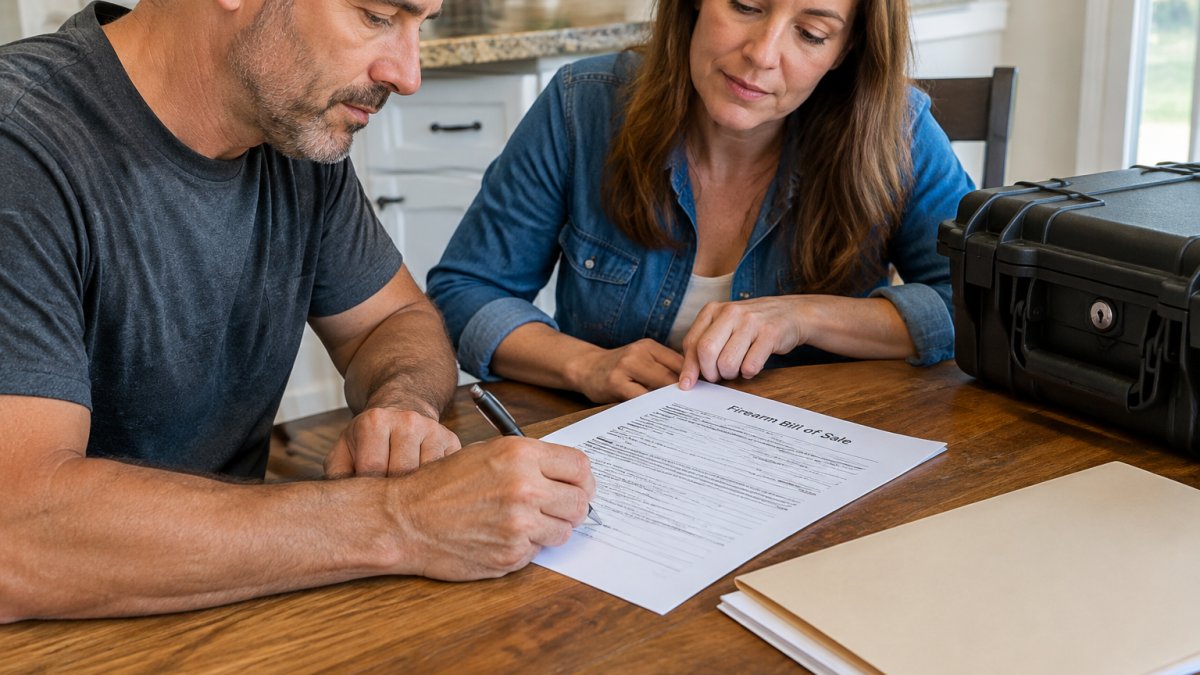
The document should match the firearm exactly. Serial number errors are common and they defeat the purpose. Read the number off the frame, not from memory.
Store the bill of sale with your other records. If you sell again, the paper trail follows the gun.
Florida Firearm Gift Rules for Family and Friends
A gift is still a transfer. Florida firearm gift rules do not create an exemption from eligibility. If you give a firearm to a family member, that person must be legally able to own it.
Federal law treats a genuine gift differently from a sale, but the recipient still must pass an eligibility check if a dealer is involved. The safest approach:
- Confirm the recipient’s age and residency
- Confirm the recipient is not a prohibited person
- Put the gift in writing, even between relatives
Inheritance and Estate Transfers
Inheritance is one of the most overlooked scenarios. When a firearm passes through an estate, the executor controls the transfer. The executor should:
- Identify each firearm by make, model, and serial number
- Confirm the heir is eligible to possess it
- Document the transfer in the estate records
- Use a licensed dealer if the heir lives in another state
A beneficiary who cannot legally own a firearm cannot receive one, even by will. The executor needs to know that before distribution.
A Step-by-Step Transfer Checklist Before You Hand Over the Firearm
Run this checklist for every transfer, private or dealer-handled. It takes minutes and prevents years of problems.
| Step | Action | Why It Matters |
|---|---|---|
| 1 | Confirm recipient age and residency | Federal and state eligibility |
| 2 | Check for prohibited-person status | Criminal exposure for both sides |
| 3 | Verify ID in person | Prevents straw purchases |
| 4 | Record make, model, serial number | Chain of possession |
| 5 | Complete bill of sale or transfer form | Written proof |
| 6 | Use a licensed dealer if interstate or NFA | Federal compliance |
| 7 | Confirm the waiting period with the dealer | Avoid a failed pickup |
A common mistake is skipping step three. Meeting at a parking lot and exchanging cash without seeing ID is how lawful sellers end up in a bad position.
Get Your Transfer Questions Answered by AlphaCalibre
The rules around a firearm transfer in Florida reward preparation and punish shortcuts. Eligibility, documentation, and the dealer question decide whether a transfer holds up.
AlphaCalibre connects you with a specialized network covering firearms, training, and security services, built since 2012. We offer personalized training and instruction for concealed carry classes.
Contact AlphaCalibre to discuss your transfer questions. Contact our team with your transfer questions.
Frequently Asked Questions
How can I legally transfer gun ownership in Florida?
It depends on the parties and the firearm. A private sale or gift between two Florida residents who are both legally allowed to possess a firearm can generally be completed face to face with no dealer involved, provided you verify eligibility and keep a written record. If the buyer lives out of state, or the firearm is a Title II item such as a suppressor or short-barreled rifle, the Florida firearm transfer must run through a licensed dealer using ATF Form 4473 and a NICS background check.
Does a firearm bill of sale need to be notarized in Florida?
No. Florida does not require a firearm bill of sale to be notarized, and there is no state registration tied to the document. A notary adds a layer of identity verification, which some sellers prefer for high-value firearms or transfers between people who do not know each other well. What matters more is that the bill of sale captures full names, government-issued identification numbers, the firearm’s make, model, caliber and serial number, the date and location of the transfer, and both signatures.
Can you gift a 20 year old a gun in Florida?
Age limits restrict who can purchase a firearm from a licensed dealer, and gift situations involve specific eligibility rules. The recipient must still be legally allowed to possess the firearm, and the gift must be a genuine gift rather than a straw purchase on someone else’s behalf. Because the age rules and exceptions are narrow, confirm the specific relationship and firearm type with a licensed dealer or attorney before handing anything over.
When is a background check required for a firearm transfer in Florida?
A background check through NICS is required whenever a licensed dealer is involved, including dealer sales, interstate transfers, and Title II firearms. Background check requirements for private sales depend on the circumstances, and eligibility screening is still advisable. Ask for government-issued identification, confirm residency, and watch for warning signs such as a buyer who refuses to show ID or asks you to sell to someone else.
