

Last Updated: November 15, 2026
Quick Summary
Hiring security guards for residential property means placing trained, uniformed personnel on site to deter crime, control access, and respond to incidents across apartment communities, HOAs, and gated neighborhoods. Start with a walkthrough to document lighting gaps, unmonitored entrances, and incident patterns, then budget for patrol and access control first.
- The U.S. security services industry reached $50.4 billion in 2026, up 1.3% year over year.
- The median annual wage for security guards was $45,370 nationally.
- A single fixed post staffed 24/7 requires roughly 168 hours of coverage per week.
- Unarmed guards suit many residential communities; armed guards fit documented violent risk or high-value assets.
- Verify state licensing, insurance, and background screening before the first shift.
Table of Contents
- Why Residential Properties Need Professional Security Guards
- Residential Security Guard Cost: What Property Managers Should Budget
- Armed vs. Unarmed Security Guards: Which Fits Your Property?
- Security Patrol Services for Residential Communities: Mobile, Foot, and Vehicle Patrols
- Your Security Guard Company Checklist: Vetting Providers, Licensing, and Insurance
- Request a Security Assessment for Your Property
- Frequently Asked Questions
Why Residential Properties Need Professional Security Guards
Hiring security guards for residential property is the practice of placing trained, uniformed personnel on site to deter crime, control access, and respond to incidents across apartment communities, HOAs, and gated neighborhoods. It works because visible security presence changes behavior before a crime happens. The U.S. security services industry reached $50.4 billion in 2026, up 1.3% year over year, according to Building Security’s 2026 guard industry statistics, and much of that demand comes from property managers protecting residents and assets.
At AlphaCalibre, we connect property managers with security professionals across Florida.
Assessing Your Community’s Security Needs
Start with a walkthrough, not a phone call. Document lighting gaps, unmonitored entrances, parking deck blind spots, and the times of day when incidents cluster. Justice Department research on private security notes that gated communities commonly hire guards to patrol premises and monitor entrances, which tells you the two functions to budget for first: patrol and access control.
Three questions shape your coverage plan:
- How many entry points can a visitor reach without passing a person or camera?
- What hours do residents report the most concern?
- Does your property have a history of vehicle break-ins, package theft, or trespassing?
HOA security and apartment security each carry different priorities, and the assessment should reflect which one describes your community.
Residential Security Guard Cost: What Property Managers Should Budget
Residential security guard cost depends on coverage hours, guard type, and staffing model, so pricing depends on the scope of each property. Contact AlphaCalibre for current pricing or a quote. Nationally, the median annual wage for security guards was $38,370, per Admiral Security’s 2026 officer guide, which gives you a wage baseline before agency overhead, supervision, insurance, and equipment.
Budget in three layers:
|
Cost Layer |
What It Covers |
How to Plan |
|---|---|---|
|
Base labor |
Guard wages for scheduled hours |
Multiply hourly wage by coverage hours |
|
Agency overhead |
Supervision, insurance, payroll taxes |
Expect a markup above wage |
|
Equipment and reporting |
Radios, uniforms, patrol vehicle, incident logs |
Confirm what the contract includes |
The layer most property managers underestimate is coverage hours, because the billable hour is not the same as the clock hour. A single fixed post staffed 24/7 requires roughly 168 hours of coverage per week.
Contract structure also moves the number. Common patterns include a flat monthly rate for a defined post schedule, an hourly rate with a minimum shift length, and a patrol-only rate billed per visit or per route.
Watch out: the cheapest bid usually strips supervision and reporting, which is exactly what you need when an incident happens. A provider that cannot explain what its markup pays for is telling you what will be missing on your site.
To build a working budget, start with the wage baseline, add the overhead percentage the provider discloses, then add equipment and reporting as line items you can compare across bids. Keep a contingency for seasonal coverage, pool areas, holiday periods, and move-in weekends often need extra hours that a base contract does not include.
Armed vs. Unarmed Security Guards: Which Fits Your Property?
Unarmed guards suit many residential communities. They handle patrol, access control, visitor management, and incident response. Armed guards make sense for properties with documented violent risk, high-value assets, or a specific threat profile.
UC Berkeley Labor Center research describes a national security-officer workforce of about 1.3 million, projected to stay roughly flat through 2034, so the difference between a good and poor fit is training and supervision, not supply. Review armed security and unarmed security options against your assessment before deciding.
Security Patrol Services for Residential Communities: Mobile, Foot, and Vehicle Patrols
Security patrol services for residential communities fall into three models: foot patrol inside buildings and amenity areas, vehicle patrol across parking lots and perimeter roads, and mobile patrol that checks multiple properties on a route. Foot patrol deters loitering where residents walk. Vehicle patrol covers ground quickly and creates visible presence at entrances.
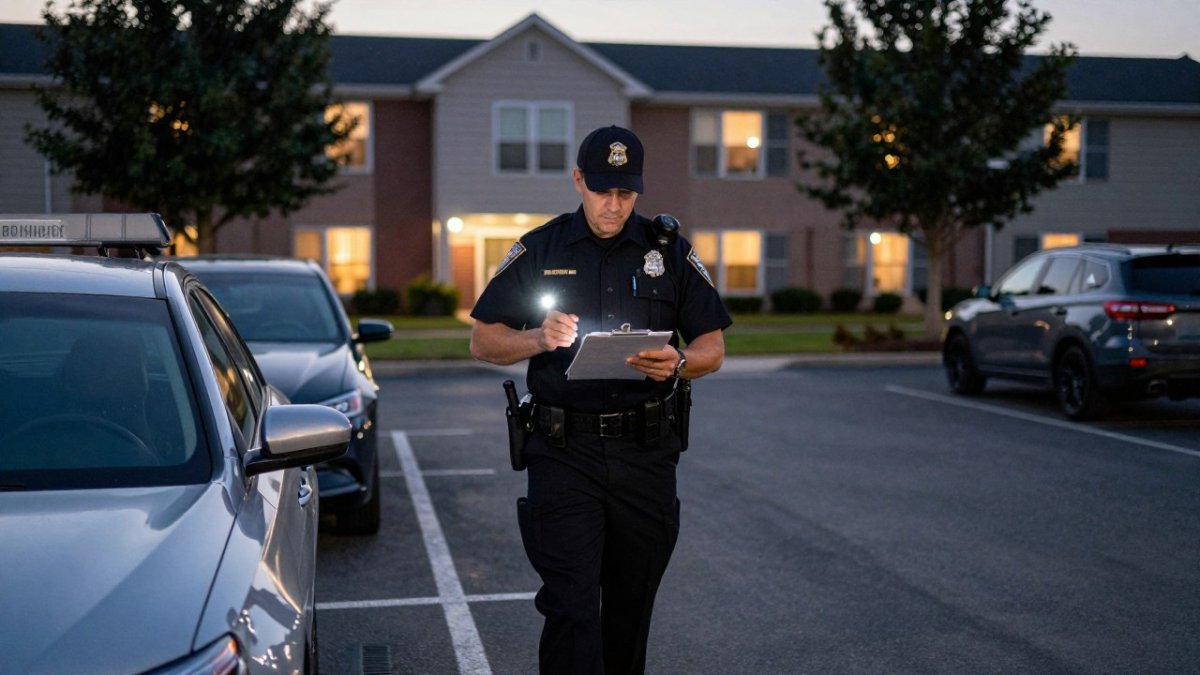
Match the model to the risk. A single-building community rarely needs a dedicated vehicle. A sprawling property with multiple lots usually does.
Your Security Guard Company Checklist: Vetting Providers, Licensing, and Insurance
A security guard company checklist protects you before the first shift. Verify state licensing for the firm and every officer assigned to your site, confirm general liability and workers’ compensation coverage, and require background screening documentation. Federal rules do not replace state licensing requirements, per the Electronic Code of Federal Regulations on private security officer employment, so ask for the state credential directly.
A list alone is not enough. For each item, know what document you are asking for and how you will confirm it is current.
- Current state agency license for the company, request the license number and check it against the state regulator’s public lookup, not just the certificate the provider sends.
- Individual guard licenses and training records, ask for the credentials of the specific officers assigned to your site, not a generic company roster.
- Certificate of insurance with your property named, confirm general liability and workers’ compensation limits, and ask to be listed as an additional insured so a claim reaches your carrier directly.
- Written post orders for your site, the document should name entry points, patrol routes, reporting steps, and escalation contacts specific to your property.
- Incident reporting process and response time, ask for a sample incident report and the expected time from event to written report.
- Supervisor visit frequency, get the scheduled frequency in writing, not a verbal assurance.
Background screening deserves its own conversation. Ask what the provider screens for, how often screening is repeated, and whether screening meets the requirements of the state where your property sits. A provider that cannot describe its screening process in specific terms is a provider that has not standardized it.
Questions to Ask Before Signing a Contract
Ask who supervises the officers, how incidents reach you, what happens when a guard calls out, and whether the contract allows rate changes mid-term. Get termination terms in writing. A provider that answers these clearly before signing will answer them clearly at 2 a.m.
Go further on contract terms. Confirm the notice period for cancellation, whether the provider can reassign officers without your approval, how the provider handles a guard who is removed from your site at your request, and what indemnification language the contract carries. Ask whether the provider’s insurance responds if a guard is accused of misconduct on your property, and confirm the answer in the certificate rather than the sales conversation. A common pattern is a contract that looks standard until an incident forces both parties to read the termination and indemnification clauses for the first time.
Watch out: a provider that resists naming its insurer, its license number, or its supervisor schedule before signing is showing you how it will handle the same requests after an incident.
Request a Security Assessment for Your Property
Hiring security guards for residential property works when the plan matches the property, the provider is properly licensed, and performance is measured after the first month. Since 2012, AlphaCalibre has connected Florida clients with security professionals through its specialized network.
Contact AlphaCalibre to discuss a security assessment for your property. Contact our team to request a security assessment and get a clear scope before you commit.
Most properties start with the wrong question: how cheap can coverage be. The better question is what your residents need protected and when. AlphaCalibre helps property managers answer that with a documented assessment, licensed personnel, and reporting you can act on. Get started with AlphaCalibre and build a security plan that holds up after the first incident.
Frequently Asked Questions
How much does it cost to hire a security guard for a residential property?
Costs vary by region, shift length, and whether guards are armed or unarmed. Property managers should request itemized quotes that separate hourly guard rates from patrol vehicle fees and administrative charges. For a small HOA, part-time or mobile patrol coverage often costs less than a full-time officer stationed on site.
What should I look for in a residential security company?
Start with state licensing: Florida requires security officers to hold a Class D license and armed guards to hold a Class G license. Confirm the company carries general liability and workers’ compensation insurance and ask what background screening it performs. Ask how they handle incident reporting and whether supervisors visit the site. A security guard company checklist should also cover response times, uniform standards, and whether guards receive training specific to residential settings, such as resident interaction and visitor management.
Should residential security guards be armed or unarmed?
Most apartment communities and HOAs choose unarmed guards because the role focuses on deterrence, access control, and incident reporting rather than enforcement. Armed guards make sense for properties with documented violent crime risk or high-value assets, . In Florida, armed officers need a Class G license on top of the Class D license. Discuss the trade-offs with your provider and review local crime data before deciding.
What duties can a security guard perform in an apartment community?
Residential security guards typically patrol the property, monitor entrances, verify visitors, document incidents, and respond to resident concerns. They can enforce parking rules, check that gates and doors are secure, and provide a visible presence that deters theft and trespassing. Guards cannot make arrests beyond citizen’s arrest limits or perform law enforcement functions. Clear post orders should define exactly what your guards will and will not do, including how they interact with residents and when to call police.
